The Constitution and Fugitive Slaves: Thoughts by Nehemiah Adams, 1854.
The Constitution of the United States must not be nullified in its fugitive slave provision . . . unless we seek to make a revolution.

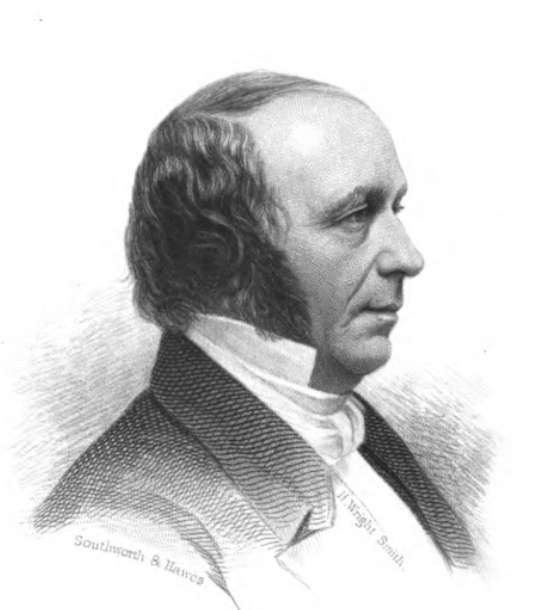
Among the provisions of the Compromise of 1850 which, significantly, brought California into the Union as a free state and allowed popular sovereignty on the slavery issue in New Mexico and Utah, was a stricter Fugitive Slave Law that required citizens to assist in the recovery of runaway slaves.
This was the dawn of a new era of resistance to slavery in the Northern States. The Abolitionists became more bold and active, and the Underground Railroad reached its peak activity. Harriet Beecher Stowe wrote Uncle Tom’s Cabin (1852), which further fueled the movement, and it seemed that passive sympathy with the slave transformed into active resistance as many states passed personal liberty laws which supported the fugitives.
Consequently, though intended to ameliorate tensions between the Free States and Slave States, the Compromise of 1850 aggravated tensions and contributed to the chasm that was filled by war. The law had the opposite effect its Southern supporters intended.
This is where Nehemiah Adams enters the picture.
Adams (February 19, 1806 – October 6, 1878) was a Harvard graduate and a Congregationalist minister from Massachusetts. He was active in anti-slavery politics and helped write petitions against allowing slavery to expand into the territories.
In 1854, he took a trip into the Southern States and subsequently wrote a book entitled, A South-Side View of Slavery (Boston, 1855). Because Adams observed what he believed to be certain beneficial, religious effects of slavery and questioned the wisdom of immediate emancipation in the South, he was not received well by the Abolitionists. The Liberator, for example, characterized his work "as vile a work as was ever written" about slavery.
In this selection, Adams addressed the issue as it relates to the Constitution.
August Glen-James, editor
Nehemiah Adams:
After we have said and done all which it is possible for human wisdom to do in making the recovery of slaves inoffensive, as things now are, there will remain in many the deep sectional difference of inborn feelings with regard to the whole subject; and it can never cease, as now viewed by both sides, from being a source of disquietude, resulting in alienations and unnumbered private and public evils, unless we all agree to abide faithfully by the Constitution until it is changed. It offends our moral sense, we will suppose, to have a man who has tried to escape and be free, taken back to involuntary servitude. But there are other interests for moral sense to be concerned about besides those of a fugitive black man. Until we are separated from the South by dividing the Union, while we live under our present Constitution, our moral sense must be more intelligent and comprehensive. We may well be reminded that moral sense agreed in 1787, for the sake of certain objects which could not otherwise be accomplished, to suffer in silence, and let persons held to service and escaping be recovered. Now, to rouse ourselves up, and say it shall not be done, is treacherous. We have obtained the benefits of constitutional government; and shall we now repudiate the compromise by which they were gained? We may use all proper means to have slavery abolished; but while it remains as it now is, we must submit to the recovery of fugitive slaves, or to anarchy, or to dissolution of the Union. All appeals to our feelings, on this subject, when the case of a fugitive slave is pending, are as really out of place, if the object be to hinder the process of law, as appeals against a sheriff's doings in attaching and selling private property.
Can any one inform us where Northern moral sense was, or whether it was in the convention when the north protracted the slave trade eight years longer than the south wished to endure it? If in the convention, it must have had leave of absence when the vote on that measure was taken. It is now very clamorous in every debate on slavery, and it ought to be called to order, being reminded that its silence or consent in 1787, works a forfeiture of all right of remonstrance now, at least till it has raised money enough to pay for three hundred thousand slaves which are here in consequence of those eight years during which the slave trade was continued by Northern votes.
When a slave has fled, and established himself in business here, and a family is rising around him, an attempt to force him back to slavery does violence to the feelings of every citizen. If a statute of limitations with regard to debts, libels, land titles, and other things, is founded on natural principles of justice, we may expect that when a better state of feeling exists between the North and South, we shall obtain a statute of limitations with regard to the recovery of slaves. Until that time, cases of a trying nature must be provided for in an amicable manner. It is easy to clamor about such cases, but it is wiser to treat them as we do other trials; and these certainly are among the afflictions which are not relieved by violence.
A distinguished advocate, defending a fugitive slave before a court, urged this as a reason why the slave should not be given up — that he might be, or would be, sold by his master as soon as he should arrive in a Southern State.
This would be a proper and commendable motive in defending one not yet proved to be a slave; but if urged as a reason why the slave, being proved such, should not be delivered to his master, it expresses, with all its kindness and tenderness, the principle of mob law. Soft and gentle, like thistle down it has a seed of evil for its centre. What though the probability were that the slave would be sold at auction as soon as he could be taken over the boundary line of a slave State? The Constitution of the United States must not be nullified in its fugitive slave provision for that reason, unless we seek to make a revolution. We must go to work in another way to make things accord with our sense of justice; and if that way be slow, it is the only way to prevent still greater evils. Until we divide the Union, or procure a change in the Constitution, if we resist one of its provisions from repugnance to it, and so nullify it, we make a breach in a dam which has behind it a desolating river. That lawyers should do or counsel this, not from professional necessity, but moved by their sensibilities, fills even some clergymen with surprise. Our clerical calling cherishes our sensibilities, makes them quick and impulsive; but a lawyer is supposed to discriminate between what is specially benevolent and the obligations which we owe to the social compact: from him we expect to learn that an unlawful way of seeking a supposed good is fraught with a destructive principle, before which every thing may be laid waste. That compassion for a fugitive slave which leads one to abrogate the constitution of society is not benevolent, nor does it secure respect from any but radicals — a class of men, in all ages of the world, who have uniformly failed to secure the confidence of mankind.
Source: Public Domain