"When a King Ceases to be King." John Locke analyzing William Barclay.
What then, Can there no Case happen wherein the People may of right, and by their own Authority help themselves, take Arms, and set upon their King, imperiously domineering over them?

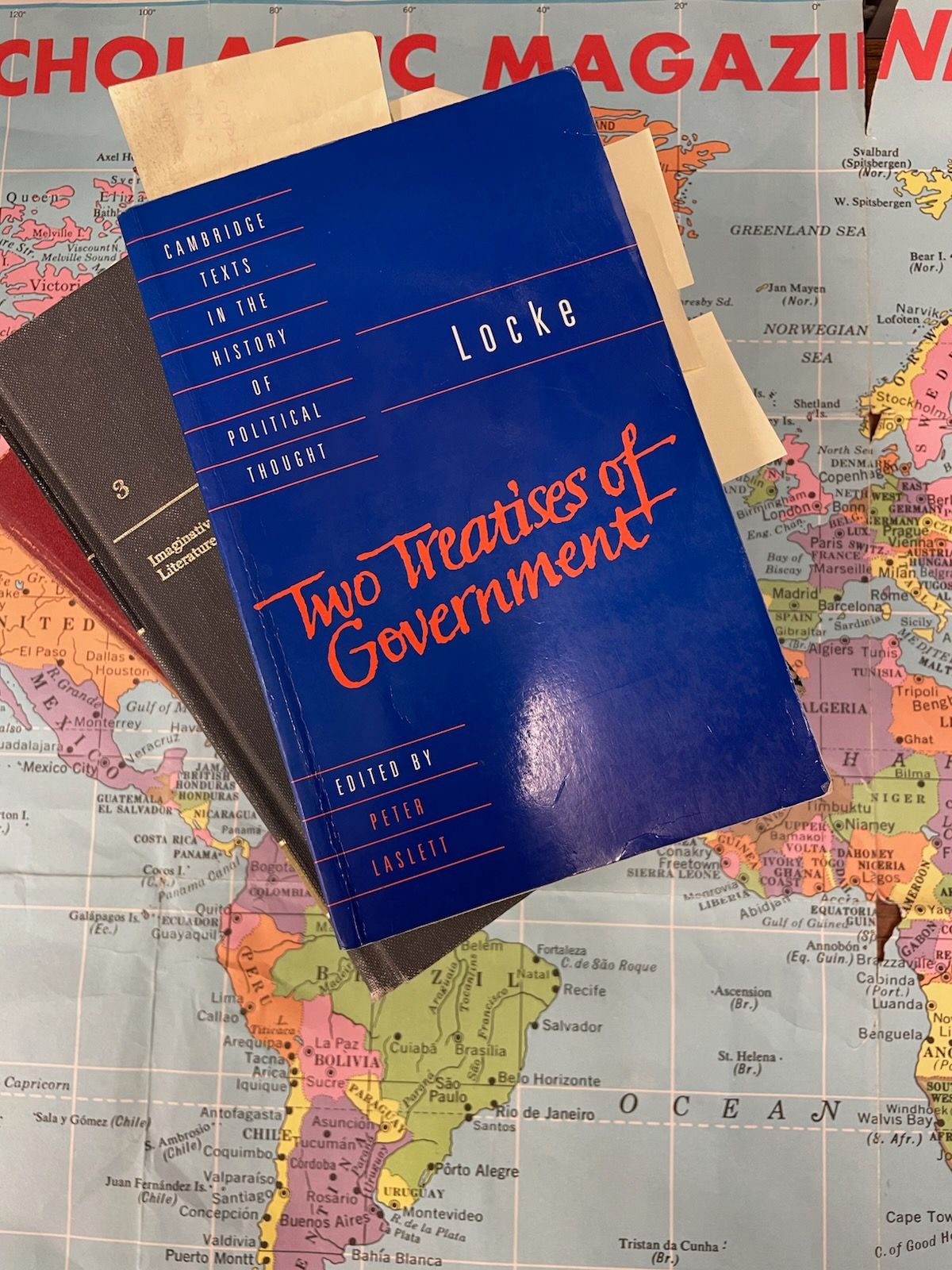
The influence of John Locke on the Founding Fathers of the United States is fairly well-known. Locke's theories are notably seen in the Declaration of Independence underwriting natural law, natural rights, consent of the governed, and the right of revolution. However, in the Declaration, Jefferson cautioned readers that governments should not be changed for "light and transient Causes."
When, then, can a government be changed or a king be ousted from power?
In Two Treatises of Government, John Locke quoted William Barclay (1546-1608) at some length to show that even “the great Champion of Absolute Monarchy” allowed for resistance to a king—when he ceases to be king.
How does one cease to be king? Read on to find out.
August Glen-James, editor
[Within the context of quoting Barclay, Locke wrote:]
"Barclay therefore, in another place, more coherently to himself, denies it to be lawful to resist a King in any Case. But he there assigns Two Cases, whereby a King may Un-king himself. . . .
“In these cases Barclay the great Campion of Absolute Monarchy, is forced to allow, That a King may be resisted, and ceases to be a King. That is in short, not to multiply Cases: In whatsoever he has no Authority, there he is no King, and may be resisted: For wheresoever the Authority ceases, the King ceases too, and becomes like other Men who have no authority.”
[Below is the excerpt Locke uses from Barclay to support his commentary written above.]
What then, Can there no Case happen wherein the People may of right, and by their own Authority help themselves, take Arms, and set upon their King, imperiously domineering over them? None at all, whilst he remains King. Honour the King, and he that resists the Power, resists the Ordinance of God; are Divine Oracles that will never permit it. The People therefore can never come by a Power over him, unless he does something that makes him cease to be a King. For then he divests himself of his Crown and Dignity, and returns to the state of a private Man, and the People become free and superior; the Power which they had in the Interregnum, before they Crown’d him King, devolving to them again. But there are but few miscarriages which bring the matter to this state. After considering it well on all sides, I can find but two. Two Cases there are, I say, whereby a King, ipso facto, becomes no King; and loses all Power and Regal Authority over his People. . . .
The first is, If he endeavor to overturn the Government, that is, if he have a purpose and design to ruine [sic] the Kingdom and Commonwealth, as it is recorded of Nero, that he resolved to cut off the Senate and People of Rome, lay the City waste with Fire and Sword, and then remove to some other place. And of Caligula, that he openly declared, that he would be no longer a Head to the People or Senate, and that he had it in his thoughts to cut off the worthiest Men of both Ranks, and then retire to Alexandria: And he wish’d that the People had but one Neck, that he might dispatch them all at a blow. Such designs as these, when any King harbours in his thoughts and seriously promotes, he immediately gives up all care and thought of the Common-wealth; and consequently forfeits the Power of Governing his Subjects, as a Master does the Dominion over his Slaves whom he hath abandon’d.
The other Case is, When a King makes himself the dependent of another, and subjects his Kingdom which his Ancestors left him, and the People put free into his hands, to the Dominion of another. For however perhaps it may not be in his intention to prejudice the People; yet because he has hereby lost the principal part of Regal Dignity, viz. to be next and immediately under God, Supreme in his Kingdom; and also because he betray’d or forced his People, whose liberty he ought to have carefully preserved, into the Power and Dominion of a Foreign Nation. By this as it were alienation of his Kingdom, he himself loses the Power he had in it before, without transferring any the least right to those on whom he would have bestowed it; and so by this act sets the People free, and leaves them at their own disposal. . . .
Locke, John. Two Treatises of Government. Edited by Peter Laslett, Cambridge University Press, 1988. PP. 424-424.